Η Φρασίκλεια (δημ. R.Marthaler, Wikimedia)
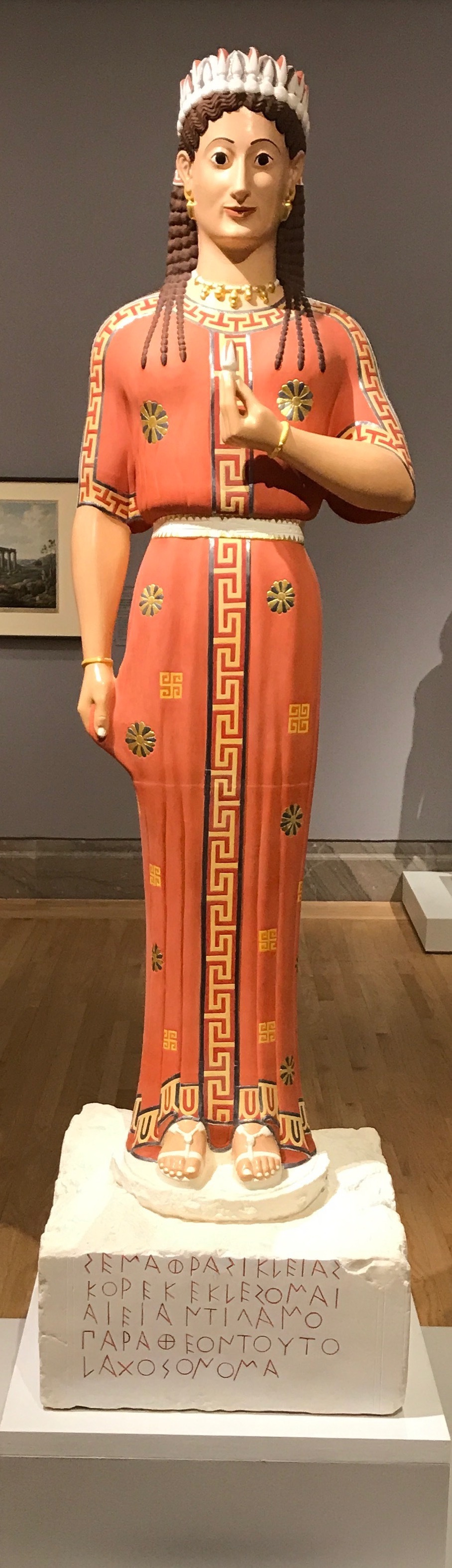
Όταν σκεφτόμαστε τα αγάλματα και τα κτίρια που πλαισίωναν τη ζωή των πρώτων χριστιανών — τους ναούς, τις αγορές, τα ιερά, τα δημόσια μνημεία — τα φανταζόμαστε συνήθως στο λευκό του μαρμάρου, μια εικόνα που ταιριάζει με αυτήν που συχνά αποκομίζουμε από τα μουσεία. Όμως η αρχαιότητα δεν ήταν έτσι. Η πολυχρωμία —βαφές, επιχρυσώσεις, ένθετα υλικά, ποικίλες τεχνικές επεξεργασίας της επιφάνειας— δεν αποτελεί σήμερα απλώς μια «προκλητική ιδέα», αλλά ένα ερευνητικό πεδίο που στηρίζεται σε υλικά ίχνη και σε αναλυτικές μεθόδους. Αυτό που προκύπτει από την έρευνα είναι ότι η αυστηρή λευκότητα του μαρμάρου κι η μονοχρωμία των αγαλμάτων είναι νεωτερική κατασκευή και όχι η αρχαία πραγματικότητα.
Η έκθεση Chroma: Ancient Sculpture in Color του Μητροπολιτικού Μουσείου της Νέας Υόρκης
(2022-2023) και ο συνοδευτικός τόμος Chroma: Sculpture in Color from Antiquity to Today, επιμ. Seán Hemingway, Sarah Lepinski, Vinzenz Brinkmann, (Yale University Press, 2025) τεκμηριώνουν με εντυπωσιακό τρόπο
αυτό που η αρχαιολογία γνωρίζει εδώ και δεκαετίες: τα ελληνορωμαϊκά αγάλματα
ήταν έντονα χρωματισμένα. Κόκκινα, κίτρινα, μπλε, πράσινα — χρώματα που
καλύπτουν σώματα, ενδύματα, μαλλιά, ακόμη και τις σκηνές μάχης και τις μυθικές
παραστάσεις που κοσμούσαν αετώματα και ζωφόρους. Η πολυχρωμία δεν ήταν
πολυτέλεια· ήταν ο κανόνας σε μεγάλο μέρος της ελληνορωμαϊκής αρχιτεκτονικής
και γλυπτικής.
Η «λευκή» κλασική αρχαιότητα που γνωρίζουμε
από τα μουσεία είναι σε μεγάλο βαθμό προϊόν της πρώιμης νεωτερικής Ευρώπης, που
ανακάλυψε τα αρχαία γλυπτά χωρίς τα χρώματά τους — διαβρωμένα από τον χρόνο —
και τα ανήγαγε σε αισθητικό ιδεώδες. Τα χρώματα είχαν εξαφανιστεί, αλλά η
απουσία τους δεν αξιολογήθηκε ως απώλεια, αλλά αναδείχθηκε σε αισθητικό κανόνα.
Ο νεοκλασικισμός —και ευρύτερα η νεότερη
αισθητική ιεράρχηση— προέκρινε το “καθαρό” μάρμαρο ως ιδανικό. Το λευκό έγινε
συνώνυμο του ευγενούς, του αυστηρού, του «κλασικού». Έτσι, ακόμη κι όταν
υπήρχαν ενδείξεις χρώματος, συχνά αντιμετωπίζονταν ως κάτι δευτερεύον ή
«ενοχλητικό», ως παρέκκλιση από την ωραία ιδέα που ήδη είχαμε σχηματίσει για
την αρχαιότητα.
Με άλλα λόγια: δεν
είναι μόνο ότι το χρώμα έφυγε από τα αντικείμενα· έφυγε και από τις προσδοκίες
μας. Και όταν η προσδοκία κυριαρχεί, οργανώνει την έρευνα: τι ερωτήσεις θα
κάνουμε, ποιες μεθόδους θα εφαρμόσουμε, ποια ευρήματα θα προβάλουμε, ποια θα
περάσουν στο περιθώριο. Στην πράξη, η ιδεολογία συχνά λειτουργεί ως σιωπηλή
προϋπόθεση κι όχι ως ρητή θέση. Κι αυτό ακριβώς την καθιστά επικίνδυνη στο
ερευνητικό έργο. Στην περίπτωση του χρώματος στον αρχαίο κόσμο η πολιτισμικά
ισχυρή προτίμηση του λευκού δεν είναι μόνο πολιτικά αλλά και επιστημολογικά
επικίνδυνη. Αν θεωρούμε εξ αρχής ότι το «αληθινό» κλασικό είναι λευκό, τότε: α)
υποβαθμίζουμε το υλικό τεκμήριο ως «λεπτομέρεια», β) μετατρέπουμε μια νεότερη
αισθητική αξία σε ιστορική κανονικότητα και γ) δυσκολευόμαστε να ανασυνθέσουμε
τον αρχαίο οπτικό κόσμο ως κόσμο διαφορετικό από τον δικό μας.
Συνειδητοποιώντας την ιδεολογική προδιάθεση
ουσιαστικά αναγνωρίζουμε μία βασική αλήθεια, ότι, δηλαδή, στην έρευνα/επιστήμη
η αυτοκριτική είναι ζωτικής σημασίας. Ο ερευνητής οφείλει να ελέγχει
συνεχώς τους φακούς του. Η μελέτη της πολυχρωμίας αποτελεί ένα τέτοιο
παράδειγμα: μας δείχνει πώς μια ισχυρή πολιτισμική προτίμηση (η πρόκριση της
λευκότητας/μονοχρωμίας) μπορεί να επηρεάσει όχι μόνο την εικόνα που έχουμε για
την αρχαιότητα, αλλά και την ίδια την επιστημονική ατζέντα.
Αν ο κόσμος του 1ου αιώνα ήταν έντονα
έγχρωμος — αγάλματα, ναοί, αναθηματικές στήλες, ταφικά μνημεία, δημόσια κτίρια,
όλα ζωγραφισμένα — τότε η αισθητική εμπειρία των πρώτων χριστιανών ήταν ριζικά
διαφορετική από αυτή που φανταζόμαστε. Οι χριστιανοί δεν κινούνταν σε έναν
κόσμο λιτής μαρμάρινης αξιοπρέπειας, αλλά σε ένα έντονα οπτικό περιβάλλον,
γεμάτο χρώμα και συμβολισμό (βλ. και προηγούμενη ανάρτηση για τις διονυσιακές παραστάσεις στα τρικλίνια).
Αυτό έχει συνέπειες για την κατανόηση της
σχέσης τους με τον γύρω κόσμο. Όταν ο Παύλος γράφει στους Θεσσαλονικείς για
«είδωλα» (1 Θεσ 1:9) ή ο συγγραφέας της Αποκάλυψης περιγράφει τη «μεγάλη
Βαβυλώνα» στολισμένη με χρυσό, πορφύρα και κόκκινο (Αποκ 17-18), δεν αναφέρονται
σε αφηρημένες έννοιες αλλά σε έναν πολύχρωμο, ζωντανό κόσμο γεμάτο οπτικά ερεθίσματα
που οι αναγνώστες τους έβλεπαν καθημερινά. Πώς διαχειρίζονταν αυτήν την
εντυπωσιακή παρουσία; Πώς αξιοποίησαν το συμβολικό φορτίο αυτών των χρωμάτων
στο δικό τους λόγο και στη συγκρότηση του δικού τους συμβολικού κόσμου;
Sarah Bond, "How
White Elites Drained Ancient Art of Its Color," Hyperallergic
(16 February 2026) [παρουσίαση
του τόμου Chroma: Sculpture
in Color from Antiquity to Today]
Πρόσθετη βιβλιογραφία
- Mark B. Abbe, "Polychromy of Antique Sculpture: A Difficult Heritage," in A Companion to Ancient Aesthetics, επιμ. Pierre Destrée, Penelope Murray. Oxford: Wiley-Blackwell, 2015, 242–257
- Sarah E. Bond, "Why We Need to Start Seeing the Classical World in Color," Hyperallergic (7 June 2017)
- Mark Bradley (επιμ.), Colour and Meaning in Ancient Rome. Cambridge: Cambridge University Press, 2009
- Vinzenz Brinkmann, Raimund Wünsche (eds.), Bunte Götter: Die Farbigkeit antiker Skulptur. Munich: Staatliche Antikensammlungen und Glyptothek, 2004
- Renée Dreyfus, Vinzenz Brinkmann, Ulrike Koch-Brinkmann (επιμ.), Gods in Color: Polychromy in the Ancient World. Munich/New York: Prestel, 2017
- Seán Hemingway, Sarah Lepinski, Vinzenz Brinkmann (επιμ.), Chroma: Sculpture in Color from Antiquity to Today. New Haven: Yale University Press, 2025
- Andrew Jones & Gavin MacGregor (επιμ.). Colouring the Past: The Significance of Colour in Archaeological Research. Oxford/New York: Berg, 2002.
When
we think of the statues and buildings that framed the lives of the first
Christians — temples, marketplaces, sanctuaries, public monuments — we tend to
imagine them in white marble, an image shaped largely by what we encounter in
museums. But antiquity did not look like that. Polychromy — pigments, gilding,
inlaid materials, varied techniques of surface treatment — is not merely a
"provocative idea" today, but an established research field grounded
in material evidence and analytical methods. What the evidence consistently
shows is that the stark whiteness of marble and the monochromy of ancient
statuary are a modern construction, not an ancient reality.
The
exhibition Chroma: Ancient Sculpture in Color at the Metropolitan Museum
of Art in New York (2022–2023) and the accompanying volume Chroma: Sculpture
in Color from Antiquity to Today, edited by Seán Hemingway, Sarah Lepinski,
and Vinzenz Brinkmann (Yale University Press, 2025), document in striking
fashion what archaeology has known for decades: Greco-Roman statues were
vividly colored. Reds, yellows, blues, greens — colors covering bodies,
garments, hair, and even the battle scenes and mythological representations
that adorned pediments and friezes. Polychromy was not a luxury; it was the
norm across a large part of Greco-Roman architecture and sculpture.
The
"white" classical antiquity familiar from museums is largely a
product of early modern Europe, which encountered ancient sculptures stripped
of their color by the passage of time and elevated their denuded state into an
aesthetic ideal. The colors had disappeared, but their absence was not
registered as a loss — it was transformed into an aesthetic standard.
Neoclassicism
— and the broader hierarchies of modern taste — privileged "pure"
marble as the ideal. White became synonymous with the noble, the austere, the
"classical." Consequently, even when evidence of color was present,
it was often treated as secondary or even inconvenient — a deviation from the
idea of antiquity already firmly in place.
In
other words: it is not only that color disappeared from the objects themselves;
it disappeared from our expectations. And when expectation dominates, it shapes
research — what questions get asked, what methods get applied, what findings
are foregrounded and what gets marginalized. In practice, ideology frequently
operates as a silent presupposition rather than an explicit position, and this
is precisely what makes it dangerous in scholarly work. In the case of color in
the ancient world, the culturally powerful preference for whiteness is not only
politically but also epistemologically hazardous. If we assume from the outset
that the "truly" classical is white, then we systematically
undervalue the material evidence as mere "detail," we transpose a
modern aesthetic value into historical normality, and we struggle to
reconstruct the ancient visual world as something genuinely different from our
own.
Recognizing
ideological predisposition means acknowledging a fundamental truth: in
research, self-criticism is indispensable. The scholar must continually examine
the lenses through which they see. The study of polychromy offers precisely
such an example — it shows how a powerful cultural preference (the privileging
of whiteness and monochromy) can affect not only the image we construct of
antiquity, but the scholarly agenda itself.
If
the world of the first century was intensely colored — statues, temples, votive
stelae, funerary monuments, public buildings, all painted — then the aesthetic
experience of the first Christians was radically different from what we
imagine. They did not move through a world of austere marble dignity, but
through a visually dense environment saturated with color and symbolism (see
also the previous post on Dionysian imagery in dining rooms).
This
has consequences for understanding their relationship to the surrounding world.
When Paul writes to the Thessalonians about "idols" (1 Thess 1:9), or
when the author of Revelation describes "great Babylon" adorned with
gold, purple, and scarlet (Rev 17–18), they are not invoking abstract concepts
but a vivid, living world full of visual stimuli that their readers encountered
every day. How did the first Christians navigate that overwhelming presence?
How did they draw on the symbolic weight of these colors in their own discourse
and in the construction of their own symbolic world?
Sarah
Bond, "How
White Elites Drained Ancient Art of Its Color," Hyperallergic
(16 February 2026) [review of Chroma: Sculpture in Color from Antiquity to
Today]
Further Reading
- Mark B. Abbe, "Polychromy of Antique Sculpture: A Difficult Heritage," in A Companion to Ancient Aesthetics, ed. Pierre Destrée, Penelope Murray. Oxford: Wiley-Blackwell, 2015, 242–257
- Sarah E. Bond, "Why We Need to Start Seeing the Classical World in Color," Hyperallergic (7 June 2017)
- Mark Bradley (ed.), Colour and Meaning in Ancient Rome. Cambridge: Cambridge University Press, 2009
- Vinzenz Brinkmann, Raimund Wünsche (eds.), Bunte Götter: Die Farbigkeit antiker Skulptur. Munich: Staatliche Antikensammlungen und Glyptothek, 2004
- Renée Dreyfus, Vinzenz Brinkmann, Ulrike Koch-Brinkmann (eds.), Gods in Color: Polychromy in the Ancient World. Munich/New York: Prestel, 2017
- Seán Hemingway, Sarah Lepinski, Vinzenz Brinkmann (eds.), Chroma: Sculpture in Color from Antiquity to Today. New Haven: Yale University Press, 2025
- Andrew Jones & Gavin MacGregor (eds.). Colouring the Past: The Significance of Colour in Archaeological Research. Oxford/New York: Berg, 2002.


