Εμφάνιση αναρτήσεων με ετικέτα μαγεία. Εμφάνιση όλων των αναρτήσεων

Τρίτη 27 Ιανουαρίου 2026

Η Γραφή ως τεκμήριο λαϊκής ευσέβειας: ένα χριστιανικό φυλακτό του 3ου αι. μ.Χ. βόρεια των Άλπεων / Scripture as Evidence of Popular Piety: A Christian Amulet from the 3rd Century CE North of the Alps

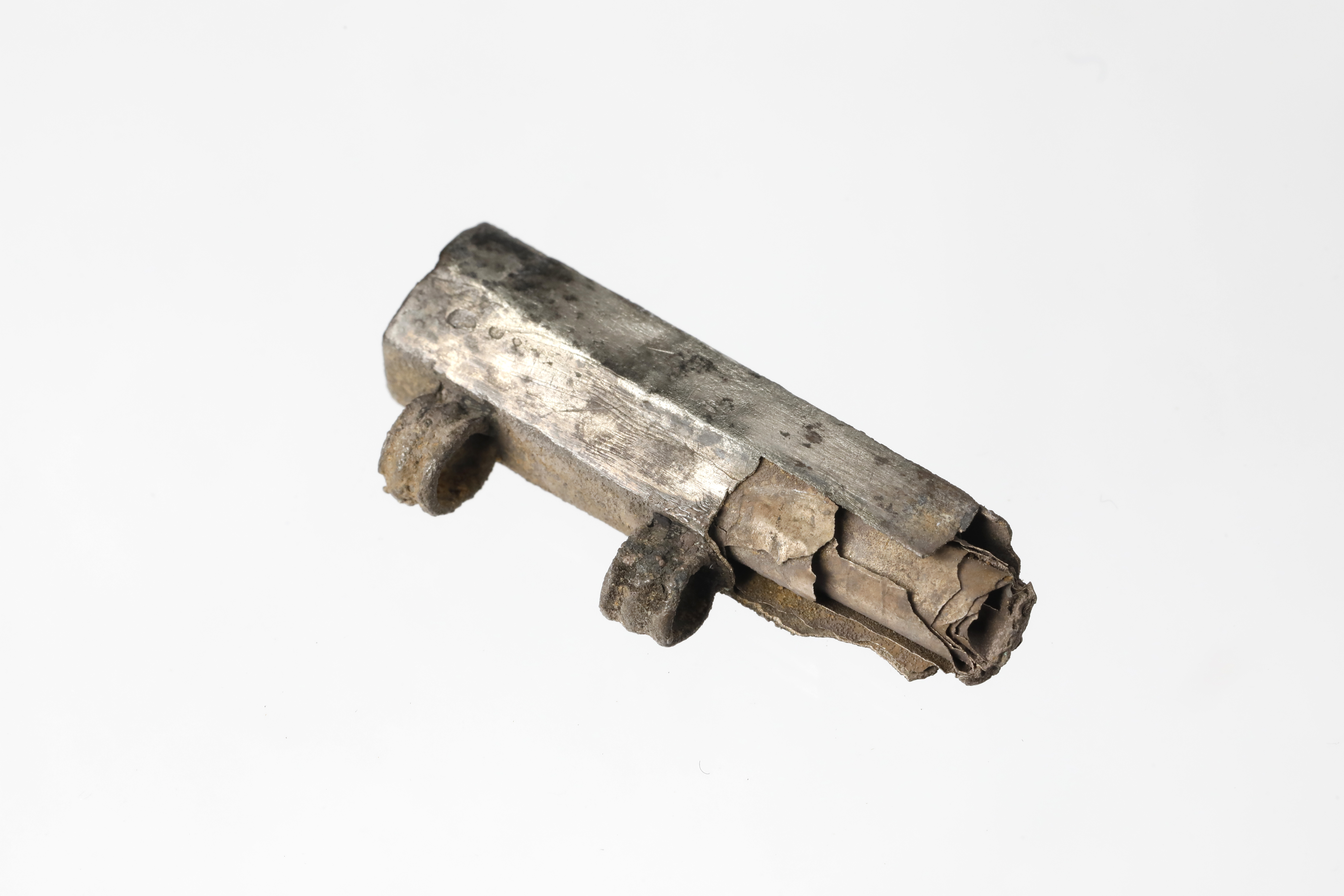
Μια εντυπωσιακή ανακάλυψη φέρνει στο φως την παλαιότερη επιγραφική χριστιανική μαρτυρία βόρεια των Άλπεων  και μας δείχνει πώς οι αρχαίοι χριστιανοί «ξαναδιάβαζαν» τον Παύλο. Πρόκειται για ένα φυλακτό (3,5 εκ.) που περιείχε ένα ασημένιο έλασμα (35-90 χιλ.) με μία εκτενή λατινική επιγραφή (18 στ.). Aς σημειωθεί ότι το υλικό για τέτοιου είδους αντικείμενα είναι συνηθισμένο (ενώ ελάσματα από μόλυβδο χρησιμοποιούνται στις defixiones). Η ανάγνωση του κειμένου κατέστη δυνατή μέσω αξονικής τομογραφίας (CT) και ψηφιακής “αποτύλιξης”, ακριβώς επειδή το άνοιγμα του ελάσματος θα οδηγούσε σε καταστροφή.

To φυλακτό (Φωτο: U. Dettmar, AMF)

Το φυλακτό κι ο σκελετός
(© Monument Office of the City of Frankfurt am Main, photo: Michael Obst )

Το φυλακτό βρέθηκε στο λαιμό ενός νεκρού άνδρα 35-45 ετών σε τάφο του ρωμαϊκού νεκροταφείου της αρχαίας Nida (περιοχή της σημερινής Φρανκφούρτης στο Praunheim). Η Nida υπήρξε στρατιωτική βάση κατά τον 1ο αι. μ.Χ. και εξελίχθηκε σε σημαντικό οικονομικό και πολιτιστικό κέντρο κατά τον 2ο αι. μ.Χ. (civitas Taunensium) Η εγκατάλειψη της πόλης περί το 260 μ.Χ. παρέχει ένα ασφαλές terminus ante quem, ενώ τα κτερίσματα του τάφου (π.χ. θυμιατήριο και κεραμικό αγγείο) τοποθετούν την ταφή μεταξύ 230–260 μ.Χ. Κατά τις εκτιμήσεις των ειδικών πρόκειται για την αρχαιότερη μαρτυρία για τη χριστιανική παρουσία στην περιοχή βόρεια των Άλπεων (οι προηγούμενες μαρτυρίες χρονολογούνται στον 4ο αι.).

Το ασημένιο έλασμα
[© Leibniz Institute for Archaeology
in Mainz (LEIZA)]


Το Κείμενο και η σημασία του
Το κείμενο, γραμμένο σε επισεσυρμένη λατινική γραφή, τη γραφή δηλαδή των καθημερινών κειμένων και των defixiones, περιέχει μία σειρά επικλήσεων και αιτήσεων για προστασία και παρουσιάζει ένα ιδιαίτερο ενδιαφέρον για παλαιογραφικούς, ιστορικούς λόγους και για την ιστορία του κειμένου και της πρόσληψής του κατά τον 3ο αι. μ.Χ. 
Το κείμενο της επιγραφής έχει ως εξής: 

1 IN NOMINE SANCTI TIT̅ I
2 AGIOS AGIOS AGIOS
3 IN NOMINE I͞H X͞P DEI F(ilii)
4 MVNDI DOMINVS
5 VIRIBVS OMNIBVS
6 INCVRSIONIBVS OPONIT
7 DEVS VALETVDINIBVS
8 SALVIS ACCESSVM
9 PRAESTAT HAEC SALUS TVEAT
10 HOMINEM QVI SE
11 DEDIT VOLVNTATI
12 DOMINI I͞H X͞P TI DEI F(ilii)
13 QVONIAM I͞ H X͞PO
14 OMNES GENVA FLEC
15 TENT CAELESTES
16 TERRESTRES ET
17 INFERI ET OMNIS LIN
18 GVA CONFITEATVR

(και η μετάφραση με βάση την αποκατάσταση του Santiago Guijarro: Στο όνομα του Αγίου Τίτου. Άγιος, Άγιος, Άγιος. Στο όνομα του Ιησού Χριστού Υιού του Θεού, ο Κύριος του κόσμου με όλη τη δύναμή του αντιτάσσεται στις επιθέσεις. Ο Θεός στις θεραπευμένες ασθένειες δίνει πρόσβαση. Αυτή η σωτηρία (ή: αυτό το φυλακτό) ας προστατεύει τον άνθρωπο που τον εαυτό του παρέδωσε στη βούληση του Κυρίου Ιησού Χριστού Υιού του Θεού. Επειδή ενώπιον του Ιησού Χριστού όλοι θα λυγίσουν τα γόνατα – οι ουράνιοι, οι επίγειοι και οι υπόγειοι – και κάθε γλώσσα θα ομολογήσει.)
Ειδικότερα: 
  • Η γλώσσα του κειμένου είναι στα λατινικά, κάτι ασυνήθιστο, αφού συνήθως φυλακτά και defixiones γράφονταν στα ελληνικά και με εβραϊκά/αραμαϊκά στοιχεία ή voces magicae
  • Δεν υπάρχει επίκληση σε διάφορους θεούς και δυνάμεις, αλλά στον απόστολο Τίτο (πιθανόν τον συνεργάτη του Παύλου) και στον Ιησού Χριστό. Ας σημειωθεί ότι είναι το πρώτο κείμενο αυτού του είδους που αναφέρεται στον Τίτο 
  • Το όνομα του Ιησού Χριστού γράφεται ως nomen sacrum στα ελληνικά (aυτό υποδηλώνει προφανώς την ιερότητα που ο συγγραφέας του κειμένου αποδίδει στο πρόσωπο του Ιησού Χριστού
  • O τρισάγιος ύμνος, γνωστός από τη λειτουργική πράξη της αρχαίας Εκκλησίας είναι στα ελληνικά, γραμμένος με λατινικούς χαρακτήρες, κάτι που ίσως υποδηλώνει την εδραιωμένη λειτουργική του πράξη ως δοξολογική φόρμουλα
  • Οι τίτλοι που αποδίδονται στον Ιησού Χριστό («υιός του Θεού, κύριος του κόσμου) παραπέμπει στην αυτοκρατορική ορολογία για το πρόσωπο του αυτοκράτορα κι έχει, επομένως, ιδιαίτερη σημασία ως ομολογία σε μία εποχή που οι χριστιανοί διώκονται
  • Το κείμενο κλείνει με μία σχεδόν κατά λέξη παράθεση στα λατινικά από το χριστολογικό ύμνο της και συγκεκριμένα το χωρίο 2:10-11
Η παράθεση του Φιλ 2:10-11
Το συγκεκριμένο καινοδιαθηκικό παράθεμα παρουσιάζει ιδιαίτερο ενδιαφέρον. Ειδικότερα, το φυλακτό από την Φρανκφούρτη διασώζει την αρχαιότερη μαρτυρία του συγκεκριμένου χωρίου στα λατινικά (ο αρχαιότερος μάρτυρας του ελληνικού κειμένου είναι ο Ρ46, περ. 200 μ.Χ.). Αποτελεί, επομένως, μία από τις αρχαιότερες μαρτυρίες της Vetus Latina, των λατινικών μεταφράσεων, δηλαδή, πριν την Vulgata του Ιερωνύμου. 
Είναι επίσης ενδιαφέρουσες οι αλλαγές τις οποίες κάνει ο συγγραφέας του κειμένου στο συγκεκριμένο φυλακτό, οι οποίες κατά την εξαιρετική ανάλυση του Guijarro έχουν και βαθύτερη θεολογική σημασία:
  • Το κείμενο εισάγεται με το αιτιολογικό quoniam αντί του τελικού/συμπερασματικού «ἵνα» του ελληνικού πρωτοτύπου. Έτσι η προσκύνηση των πάντων στον Ιησού αποτελεί την απόδειξη της δύναμης του Ιησού (ενώ το τελικό ή συμπερασματικό «ἵνα» υποδηλώνει ότι η καθολική υποταγή είναι η συνέπεια της κένωσης και της υπακοής του Χριστού. Με αυτόν τον τρόπο, το φυλακτό μετατρέπει τον θεολογικό ύμνο ταπείνωσης σε κείμενο δύναμης και προστασίας. 
  • Αποδίδει με το omnes genua και το μελλοντικό χρόνο flectent, κάτι που ταιριάζει στον αποτροπαϊκό χαρακτήρα του φυλακτού.
Συμπερασματικά
Το φυλακτό της Φρανκφούρτης αποτελεί ένα ακόμη εξαιρετικό παράδειγμα του πώς η επιγραφική υποστηρίζει τη μελέτη της ιστορίας του κειμένου της Καινής Διαθήκης και της πρόσληψής του κατά την αρχαιότητα. Αποτελεί, επίσης, μία σημαντική μαρτυρία για το πώς εκείνοι οι αρχαίοι χριστιανοί βίωσαν την πίστη τους. Η αναφορά στον Τίτο και το παύλειο κείμενο, στην προκειμένη περίπτωση, βεβαιώνει τη σημασία που έχει η παύλεια παράδοση σε αυτήν την πρώιμη περίοδο στο δυτικό τμήμα της αρχαίας Εκκλησίας. 
Οι επικλήσεις στο πρόσωπο του Ιησού, ο χαρακτήρας του ευρήματος και ο τρόπος που αξιοποιείται το Φιλ 2:10-11  υπενθυμίζουν  ότι υπήρχαν πολλοί τρόποι να είσαι χριστιανός στον 3ο αιώνα – και ότι η θρησκεία των καθημερινών ανθρώπων, αυτών που αγωνίζονταν να επιβιώσουν στα σύνορα της αυτοκρατορίας, είχε τις δικές της στρατηγικές ανάγνωσης της Γραφής και συχνά αξιοποιεί το βιβλικό κείμενο ως αντικείμενο πίστης. Ο ίδιος βιβλικός στίχος μπορεί να σημαίνει διαφορετικά πράγματα για διαφορετικούς ανθρώπους – και ότι αυτό είναι μέρος της πλούσιας ιστορίας της πρώιμης Εκκλησίας.

Βιβλιογραφία
--------------------------------------------------------------------------
A remarkable discovery reveals how ancient Christians "re-read" Paul for everyday protection
A remarkable discovery brings to light the earliest Christian evidence north of the Alps. An amulet (3.5 cm) containing a silver sheet (35-90 mm) with an 18-line Latin inscription was found around the neck of a man aged 35-45 in a tomb at the Roman cemetery of ancient Nida (modern Frankfurt, Praunheim). Reading the text was made possible through CT scanning and digital "unrolling."
The city's abandonment around 260 CE provides a secure terminus ante quem, while the tomb's grave goods place the burial between 230–260 CE. This is the earliest epigraphic evidence of Christian presence in the region north of the Alps (previous evidence dates to the 4th century).

The Text and Its Significance
The text, written in cursive Latin script—the script of everyday texts—contains a series of invocations and requests for protection. The English translation (based on Santiago Guijarro's reconstruction):

"In the name of Saint Titus. Saint, Saint, Saint. In the name of Jesus Christ Son of God. The Lord of the world with all his might faces attacks. God, to the diseases healed grants access. This salvation (this amulet?) may protect the man who himself surrendered to the will of the Lord Jesus Christ Son of God. For before Jesus Christ everyone knees shall bend, those of heavens, those of the earth and those underneath and all tongue confess."

Key features:
  • Written in Latin (unusual—most amulets were in Greek with Hebrew/ Aramaic elements and voces magicae)
  • Invokes the apostle Titus (probably Paul's collaborator) and Jesus Christ—the first text of this kind referring to Titus
  • Jesus Christ's name written as Greek nomina sacra, indicating veneration
  • The Trisagion in Greek written with Latin characters, suggesting established liturgical practice
  • Titles for Jesus ("Son of God," "Lord of the world") echo imperial terminology—a significant confession in an era of persecution
  • Closes with an almost word-for-word Latin quotation from Philippians 2:10-11

The Philippians 2:10-11 Quotation
This is of special interest. The Frankfurt amulet preserves the earliest witness of this passage in Latin (the earliest Greek witness is P46, ca. 200 CE), making it one of the earliest attestations of the Vetus Latina.
The changes made by the author have deeper theological significance (Guijarro's analysis):
The text is introduced with the causal "quoniam" instead of the final "ἵνα" of the Greek original. Thus the worship of all to Jesus constitutes proof of Jesus' power (while the Greek "ἵνα" indicates that universal submission is the consequence of Christ's kenosis and obedience).
It renders with "omnes genua" and the future tense "flectent," which suits the apotropaic character of the amulet.
With this change, the amulet transforms the theological hymn of humiliation into a text of power and protection.

In Conclusion
The Frankfurt amulet exemplifies how epigraphy supports the study of New Testament textual history and its ancient reception. The reference to Titus and the Pauline text confirms the importance of Pauline tradition in the early western Church.
The invocations to Jesus, the character of the find, and the way Phil 2:10-11 is utilized remind us that there were many ways to be Christian in the 3rd century—and that the religion of everyday people struggling to survive on the empire's frontiers had its own reading strategies for Scripture and often utilized biblical text as an object of faith. The same biblical verse could mean different things to different people—and this is part of the rich history of the early Church.

Bibliography:

Παρασκευή 9 Σεπτεμβρίου 2022

Το τρέχον τεύχος του NTS / The current issue of NTS

 New Testament Studies 68/4 (2022)

Σάββατο 20 Αυγούστου 2022

Στο τρέχον τεύχος του Greece & Rome / In the current issue of Greece & Rome

Greece & Rome 69/1 (2022)

Curses in Context IV: Curse Tablets in the Wider Realms of Execrations, Commerce, Law, and Technology 

Πέμπτη 10 Μαρτίου 2022

Το τρέχον τεύχος του NTS / The current issue of NTS

New Testament Studies 68/2 (2022)

  • Margaret M. Mitchell, "John Chrysostom and Christian Love Magic: A Spellbinding Moment in the History of Interpretation of 1 Cor 7.2–4," 119-143 (abtsract)
  • Rowe C. Kavin, "What if it were True? Why Study the New Testament," 144-155 (abstract)
  • Garrick V. Allen, "Titles in the New Testament Papyri," 156-171 (open access)
  • Matthew Pawlak, "Paul's Escape from Damascus (2 Cor 11.32–3) and the corona muralis," 172-187 (open access)
  • David A. Evans, "Κολληθέντɛς in Acts 17.34 and the Establishment of the Athenian Church," 188-205 (abstract)
  • Ivan Miroshnikov, "A New Witness to the Fayyūmic Version of First Corinthians (P.MorganLib. 265). Part II: Notes on its Text-Critical Value, with an Edition of the Coptic Text,"  206-230 (open access)  

Τρίτη 1 Φεβρουαρίου 2022

Το τρέχον τεύχος του JSJ / The current issue of JSJ

 Journal for the Study of Judaism 53/1 (2022)

Σάββατο 7 Αυγούστου 2021

Το τρέχον τεύχος του RRE / The current issue of RRE

 Religion in the Roman Empire 7/1 (2021)

Curses in Context, 2: Curses in the Eastern and North African Provinces of the Roman Empire

  • Richard L. Gordon, "Curse-Practices in the Late-Antique Roman Levant and North Africa," 3-18 (abstract)
  • Roger S. O. Tomlin, "The Latin Curses from Uley and Other Sanctuaries in Britain," 19-30 (abstract)
  • Riccardo Vecchiato, "Crucified and Beheaded: The Archaeological Context of the Amathous Curses (DTAud 22–37)," 31-42 (abstract)
  • Andrew T. Wilburn, "The Selenite and Lead Curse Tablets from Amathous, Cyprus and the Transmission of Magical Technology," 43-70 (abstract)
  • Robert Daniel, "A Vestige of the Ptolemaic Crocodile Cult in a Curse from Caesarea Maritima against a Pantomime Dancer," 71-77 (abstract)
  • Attilio Mastrocinque, "Cursing Dancers in the Roman Levant: A Forgotten Text in Milan," 78-95 (abstract)
  • Raquel Martín Hernández, "The Figural Representation of Victims on Agonistic Late-Antique Curse Tablets," 96-124 (abstract)
  • Christopher A. Faraone, "The Curse Tablets of PGM VII: A North African Tradition?" 125-148 (abstract)
  • Ortal-Paz Saar, "Jewish Curse Tablets?" 149-166 (abstract)
  • Korshi Dosoo, "The Powers of Death: Memory, Place and Eschatology in a Coptic Curse," 167-194 (abstract)
  • Nicole Belayche, "Curse Tablets in the Eastern Provinces of the Roman Empire," 195-213 (abstract)


Παρασκευή 16 Ιουλίου 2021

Το τρέχον τεύχος του JBL / The current issue of JBL

 Journal of Biblical Literature 140/2 (2021)

  • David J. A. Clines, "Alleged Female Language about the Deity in the Hebrew Bible," 229-249 (abstract)
  • David M. Carr, "Competing Construals of Human Relations with “Animal” Others in the Primeval History (Genesis 1–11)," 251-269 (abstract)
  • Paba Nidhani De Andrado, "Hannah’s Agency in Catalyzing Change in an Exclusive Hierarchy," 271-289 (abstract)
  • Will Kynes, "Wrestle On, Jacob: Antebellum Spirituals and the Defiant Faith of the Hebrew Bible," 291-307 (abstract)
  • Hindy Najman, "Imitatio Dei and the Formation of the Subject in Ancient Judaism, 309-323 (abstract)
  • Troy M. Troftgruben, "The Ending of Luke Revisited, " 325-346 (abstract)
  • Laura Salah Nasrallah, "Judgment, Justice, and Destruction: Defixiones and 1 Corinthians," 347-367 (abstract)
  • T. Christopher Hoklotubbe, "Civilized Christ-Followers among Barbaric Cretans and Superstitious Judeans: Negotiating Ethnic Hierarchies in Titus 1:10–14," 369-390 (abstract)
  • Kim Papaioannou, "The Sin of the Angels in 2 Peter 2:4 and Jude 6," 391-408 (abstract)
  • TGarrick V. Allen, "The Possibilities of a Gospel Codex: GA 2064 (Dublin, CBL W 139), Digital Editing, and Reading in a Manuscript Culture," 409-434 

Τρίτη 6 Ιουλίου 2021

Το τρέχον τεύχος του Early Christianity / The current issue of Early Christianity

 Early Christianity 12/2 (2021)

  • Isaac T. Soon, "The Short Apostle: The Stature of Paul in Light of 2 Cor 11:33 and the Acts of Paul and Thecla," 159-178 (abstract)
  • Stefan Krauter, "Foul! Romans 9–11 and Athletic Contests in Ancient Epic," 179-199 (abstract)
  • Beatrice Wyss, "Die Brotrede Philons aus Alexandreia in Legum allegoriae 3,169–178," 200-227 (abstract)
  • Carl Johan Berglund, "References to Heracleon in Clement of Alexandria," 228-247 (abstract)

New Discoveries 

  • Roy D. Kotansky, "The So-Called »Christ« Magician's Cup," 251-261

New Projects

  • Tobias Nicklas,  "»Beyond Canon«: Eine kurze Erläuterung des Projekts," 265-275

Παρασκευή 5 Μαρτίου 2021

Γυναίκες και μαγεία στην Παλαιά Διαθήκη; / Women and magic in the Old Testament

 Ο Jonathan Rabinowitz (Bar Ilan University) συζητά τη μοναδική περίπτωση μέσα στην Παλαιά Διαθήκης πιθανής αναφοράς σε γυναίκες μάγισσες κι εξηγεί πώς η γενικότερη σύνδεση της μαγείας με τη γυναίκα στον αρχαίο πέρασε και στην ιστορία πρόσληψης του συγκεκριμένου χωρίου: 

Accusing Women of Witchcraft

Δευτέρα 22 Φεβρουαρίου 2021

Πέμπτη 18 Φεβρουαρίου 2021

Στο τρέχον τεύχος του HTR / In the current issue of HTR

 Harvard Theological Review 114/1 (2021)

  • Harry Tolley, "The Jewish–Christian Dialogue Jason and Papiscus in Light of the Sinaiticus Fragment," 1-26 (abstract)
  • Eugene C. Tibbs, "'Do Not Believe Every Spirit': Discerning the Ethics of Prophetic Agency in Early Christian Culture," 27-50 (abstract)
  • Sarah Parkhouse, "Identity, Death, and Ascension in the First Apocalypse of James and the Gospel of John," 51-71 (abstract)
  • Amit Gvaryahu, "Usury and Poverty: A Case Study of the Post-Rabbinic Moment in Midrash and Piyyut," 72-95 (abstract)
  • Michael Motia, "Three Ways to Imitate Paul in Late Antiquity: Ekstasis, Ekphrasis, Epektasisl," 97-117 (abstract)
  • Lincoln H. Blumell, Korshi Dosoo, "A Coptic Magical Text for Virginity in Marriage: A Witness to “Celibate Marriage” from Christian Egypt," 118-142 (abstract)


Τρίτη 15 Δεκεμβρίου 2020

Στο τρέχον τεύχος του JJS / In the current issue of JJS

 Journal of Jewish Studies 71/2 (2020)

Avigail Manekin-Bamberger, "Who were the Jewish ‘magicians’ behind the Aramaic incantation bowls?" 235-254

This article focuses on the social and professional contexts of the producers of Jewish Aramaic incantation bowls. Based on the vast amount of legal terminology deployed in the bowls, as well as a reference to bowl writers as ‘writers of books’ in bowl AMB6, I argue that bowl scribes were part of a professional guild of scribes (soferim) that engaged in a variety of forms of Jewish writing. Furthermore, I suggest that the scribal context of the practitioners of the magic bowls was different from the professional context of the contemporaneous corpus of Jewish metal amulets. Identifying the unique Sitz im Leben of the bowls reveals that for Jews in Sasanian Babylonia the line between magic, law and religion was not rigid, and perhaps non-existent. Further work on the context of ancient Jewish magic may therefore lead to new perceptions of ancient Jewish society.

Sonja Noll, "In pursuit of a hapax: divergent interpretations of the root s-k-t," 255-268

A shift occurred in the lexicographical tradition of the hapax legomenon הַסְכֵּת (Deut. 27:9) between the seventeenth and nineteenth centuries. The hiphil imperative had previously been understood to mean ‘listen’ or ‘pay attention’, a tradition reflected in the Targumim, Peshitta, Vulgate, Aquila and early dictionaries. With the introduction of Arabic cognate evidence into Hebrew dictionaries in the seventeenth century, however, the meaning ‘be silent’, from the Arabic cognate سكت, began to appear in entries for this root. Dictionaries also began to include the translation σιώπα, ‘be silent’, from the Greek Septuagint, and eventually the gloss ‘be silent’ replaced ‘listen’ in bilingual biblical Hebrew dictionaries. The difference in meaning is minor, but this case study serves to illustrate the striking influence of cognate scholarship on the development of biblical Hebrew dictionaries.

Reuven Friedman, "A tale of two baraitot: the Western Galilee borders of the rabbis in archaeology and texts," 269-296

The purported border of Jewish settlement in the Western Galilee is identified in two separate tannaitic texts, each referring to the ̔Akko–Akhziv road. One text cites this road as the western border of Jewish settlement, while the other cites the same road as the eastern border. The border of Jewish settlement is also described in another rabbinic text, also discovered in the Reḥov synagogue excavations. This text is inconsistent with the texts referring to the ̔Akko–Akhziv road. Archaeologists give priority to the Reḥov inscription and dismiss the contradictory texts as a scribal error. Talmudic scholars validate the authenticity of the apparently contradictory texts using critical textual analysis, but leave the apparent contradictions unresolved. This article uses archaeological evidence in conjunction with a critical review of the texts to resolve the apparent contradiction, proving that the rabbinic texts authenticated by Talmudic scholars are consistent with the Reḥov inscription.

Πέμπτη 15 Οκτωβρίου 2020

Στο τρέχον τεύχος του JJS / In the current issue of JJS

 Journal of Jewish Studies 7/1 (2020)

  • Avigail Manekin-Bamberger, "Who were the Jewish ‘magicians’ behind the Aramaic incantation bowls?" 253-268 (abstract)
  • Sonja Noll, "In pursuit of a hapax: divergent interpretations of the root s-k-t,"  255-268 (abstract)
  • Reuven Friedman, ''A tale of two baraitot: the Western Galilee borders of the rabbis in archaeology and texts," 269-296 (abstract)


Παρασκευή 21 Αυγούστου 2020

Στο τρέχον τεύχος του Arethusa / In the current issue of Arethusa

Arethusa 53/1 (2020)

  • Cat Lambert, "The Ancient Entomological Bookworm," 1-24
  • Charlotte Northrop, "Caeneus and Heroic (Trans)Masculinity in Ovid’s Metamorphoses," 25-41 (abstract)
  • David Frankfurter, "“Voodoo Doll”: Implications and Offense of a Taxonomic Category," 43-58 (abstract)

Κυριακή 12 Απριλίου 2020

Το τρέχον τεύχος του Revue Biblique / The current issue of Revue Biblique

Revue Biblique 127:1 (2020)

  • Grzegorz M. Baran, "'Mother of the Nation (mḗtēr éthnous)' (4 Macc. 15:29): Mother of Seven Maccabaean Sons as Patriarchess of New-Quality Nation," 5 - 34 (abstract)
  • Markus Lau, "Capta et devicta? Eine mk Gegenerzählung zur römischen Judaea-Capta-Münzprägung - Anmerkungen zur literarischen Technik einer narrativen Münzüberprägung in Mk 5,1-20," 35 - 63 (abstract)
  • Anne de Saxcé, "La citation dans la pensée de saint Augustin," 64 - 81 (abstract)
  • Reinhard Pummer, "What was the Meaning and Purpose of Amulets with Samaritan Writing in the Byzantine Period?" 82 - 104 (abstract)
  • Madeleine Mumcuoglu - Yosef Garfinkel, "Gate Piazza and Cult at Iron Age IIA Tell el-Far'ah North," 105 - 129 (abstract)
  • Lucie Duvignac - Awni Shawamra, "Des sarcophages samariens conservés à Jénine," 130 - 135


Παρασκευή 17 Ιανουαρίου 2020

Στο τρέχον τεύχος του RRE / In the current issue of RRE

Religion of the Roman Empire 5/2 (2019)

  • Julien Aliquot, "Heliopolitan Capitolia: From Greek Games to Christian Pilgrimage," 145-169 (abstract)
  • Jonathan A. Pomeranz, "The Humility of God in Rabbinic Judaism: Rabbinic Myth in the Roman Empire," 170-195 (abstract)
  • Jason J. Ripley, "The Genre of John and the Rule of Rome: Imperial Readers, Johannine Testimony, and the Death of the Author," 196-245 (abstract)
  • Jan N. Bremmer, "Simon Magus: The Invention and Reception of a Magician in a Christian Context,"  246-270 (abstract)
  • Maik Patzelt, "'Praying as a 'Woman among Men': Reconsidering Clodius' Failed Prayer in Cicero's Speech On his House," 271-291 (abstract)
  • Jörg Rüpke, "Roman Gods and Private Property: The Invention of State Religion in Cicero's Speech On His House," 292-315 (abstract)


Σάββατο 5 Οκτωβρίου 2019

Στο τρέχον τεύχος του BASP / In the current issue of BASP

Bulletin of the American Society of Papyrologists 56 (2019)

  • Nikos Litinas, "On the Usefulness of the North Wind in a Chreia Diogenis Cynici (P.Mich. inv. 6216z20): An Ancient Student Response Card?" 39-53 (abstract)
  • Lajos Berkes - W. Graham Claytor, "Two Petitions Addressed to Village Epistatai," 55-63 (abstract)
  • Matt Gibbs - C. Michael Sampson, "A First-Century Receipt from the Receivers of Public Clothing in Tebtunis (P.Tebt.UC 1607c)," 65-78 (abstract
  • Adrienn Almásy-Martin -   Ruth Duttenhöfer, "Greek Tax Receipts from Abydos in the British Museum," 79-93 (abstract)
  • Giulio Iovine, "Unpublished Latin Papyri from Dura-Europos at the Beinecke Library," 95-116 (abstract)
  • Graziano Ranocchia, "P.Herc. 1015/832: Book 15, 16, or 19 of Philodemus' On Rhetoric?" 167-172 (abstract)
  • Jacob W. Peterson, "An Updated Correction List for Chester Beatty BP II + P.Mich. Inv. 6238 (Gregory-Aland Papyrus 46 [P46])," 173-195 (abstract)
  • Richard L. Phillips, "Ritual Evidence and the Art of Going Unnoticed in PGM I 222-231 and 247-262," 197-203 (abstract)
  • Christopher A. Faraone, "Protection against Fear of Punishment from Hecate Ereschigal: Another Look at a Magical Recipe in Michigan (PGM LXX 4-19)," 205-224 (abstract)
  • Eddy Lanciers, "Antaios, a Ptolemaic Strategos of Alexandria," 225-231 (abstract)
  • Thomas Backhuys, "Apomoira für die Rachegöttinnen: Neuedition von PUG 4.155," 233-249 (abstract)
  • Charikleia Armoni, "Notes on Papyri," 251-257 (abstract)
  • Ines Bogensperger - Aikaterini Koroli, "Textile Terminology in the Apollonios Archive: A New Approach to the Meaning of Entype in P.Giss.Apoll. 20," 259-274 (abstract)
  • A. Papathomas - N. Kanavou, "P.Philammon, 'Law Cases' 1-6 (= BGU 4.1024, pp. 3.1-6.2): Some Textual Notes," 275-286 (abstract)