Στον τόμο έρχονται σε διάλογο δύο συγγενικές αλλά και διακριτές ερευνητικές περιοχές: η παπυρολογία και η επιγραφική. Αυτό που αναδεικνύεται είναι ότι η διάταξη και η μορφή του κειμένου δεν επηρεάζουν μόνο τον τρόπο ανάγνωσης, αλλά καθορίζουν και τον κοινωνικό του ρόλο. Το υλικό που το φέρει μπορεί, με τη σειρά του, να υποδηλώνει λειτουργία, κύρος ή και ιερότητα. Η σχέση κειμένου–μέσου–μορφής δεν είναι μονόδρομη, αλλά αμφίδρομη και σύνθετη.
Ξεχωρίζω, ανάμεσα στις εξαιρετικές μελέτες του τόμου, εκείνες του Nicola Reggiani για το Χ-Ρ (chi-rho) και το σταυρόγραμμα στους παπύρους (“Crossing Abbreviations, Monograms, and Symbols”), του Lucio Del Corso για την υλικότητα της γραφής και τις συμβάσεις της στην Αίγυπτο της ύστερης αρχαιότητας (“Epigraphic Habits and Writing Conventions in Late Antique Egypt”), καθώς και των Francesca Maltomini και Francesca Murano για τον επιτελεστικό χαρακτήρα της γραφής στα μαγικά κείμενα (“The Binding Layout? On Graphic Strategies in Greek Magical Texts”).
Για όσους εργάζονται με χειρόγραφα της Καινής Διαθήκης και παλαιοχριστιανικά κείμενα ή αξιοποιούν επιγραφές στη μελέτη της ΚΔ, το βιβλίο προσφέρει πολύτιμες προοπτικές. Οι μελέτες του τόμου καταδεικνύουν ότι το κείμενο είναι ένα υλικό γεγονός, με συγκεκριμένη λειτουργία σε χρόνο και τόπο—και ότι ο τρόπος που «στήνεται» πάνω στο μέσο γραφής αποτελεί μέρος της επικοινωνίας με το αναγνωστικό κοινό.
Με τη συνεξέταση κειμένου, διάταξης/μορφής και υλικού φορέα, ο τόμος προσφέρει μια μεθοδολογικά γόνιμη σύνθεση ανάμεσα σε παπυρολογία και επιγραφική και καθιστά σαφές ότι η υλικότητα του κειμένου δεν αποτελεί ένα δευτερεύον ζήτημα αλλά μέρος της ιστορικής του συγκρότησης. Το κείμενο κατανοείται ως καταγραφή σε συγκεκριμένο μέσο, με συμβάσεις διάταξης και ορίζοντες χρήσης που διαμορφώνουν την αναγνωστική εμπειρία και τη κοινωνική λειτουργία των κειμένων. Για την έρευνα της Καινής Διαθήκης, των παλαιοχριστιανικών κειμένων και των επιγραφικών μαρτυριών, η οπτική αυτή λειτουργεί ως κρίσιμο ερμηνευτικό συμπλήρωμα: η μορφή και διάταξη, τα σύμβολα και τα σημεία γραφής σημεία προσλαμβάνονται ως δεδομένα που καθορίζουν το νόημα, τη χρήση και την πρόσληψη του κειμένου.
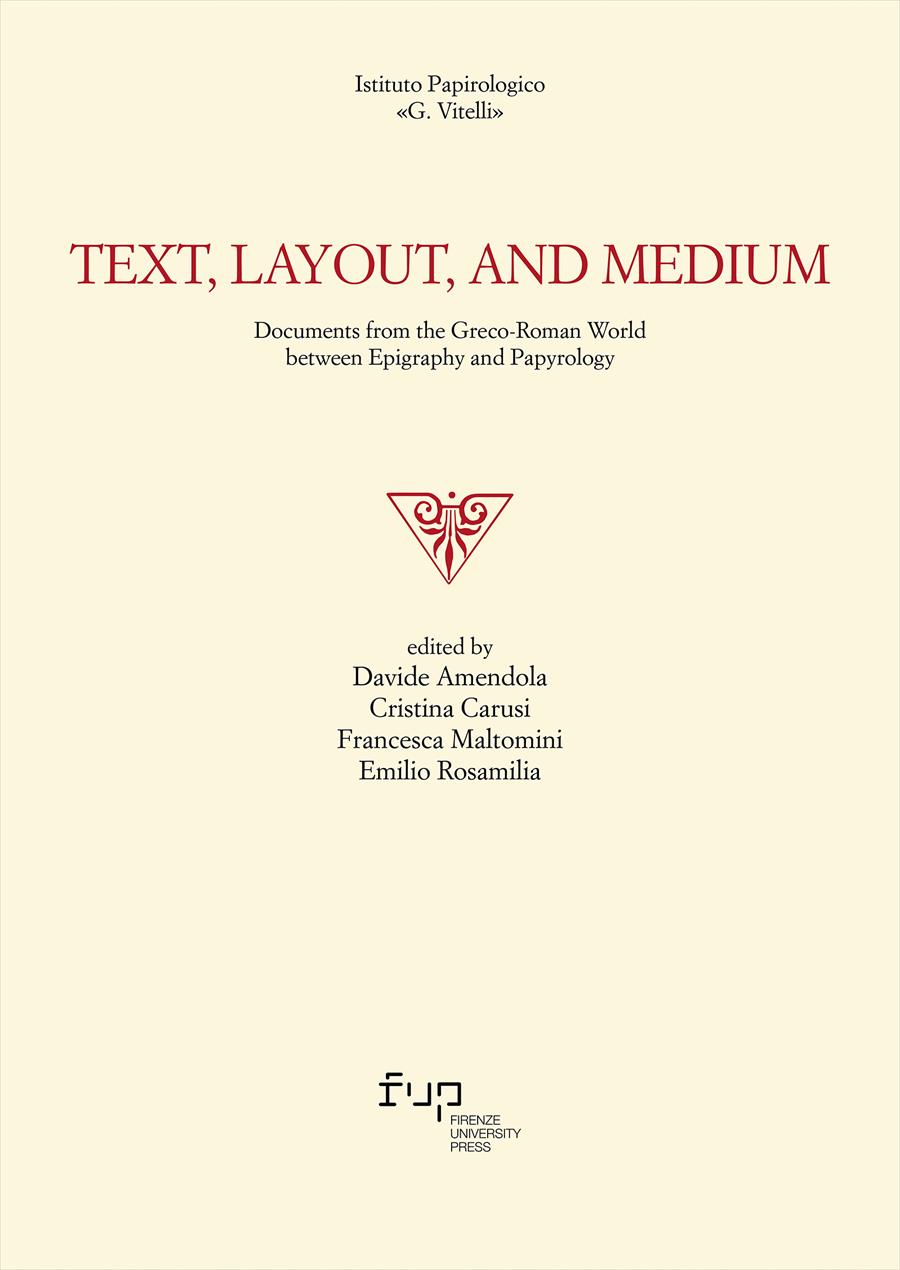
Davide Amendola, Cristina Carusi, Francesca Maltomini, Emilio Rosamilia-(επιμ.), Text, Layout, and Medium: Documents from the Greco-Roman World between Epigraphy and Papyrology (Firenze University Press, 2024) [Open Access: CC BY 4.0]
------------------------------------------------------
Ancient texts are often approached as detached from their material dimension: immaterial and unchanging across time and space. In reality, however, texts always have a material aspect. They are inscribed on various media—papyrus, stone, ostraca, wood, walls—and the form and layout they take on these surfaces (columns, spaces, markers, symbols, abbreviations) are not neutral. They indicate their character and function and guide the reader in how to read and use them. This fundamental insight forms the basis of the edited volume Text, Layout, and Medium: Documents from the Greco-Roman World between Epigraphy and Papyrology (Firenze University Press, 2024): it demonstrates how medium, layout, and form are not elements irrelevant to the text, but part of the very process of communication between text and reader.
The volume brings into dialogue two related yet distinct fields of research: papyrology and epigraphy. What emerges is that the layout and form of a text do not merely affect how it is read, but also determine its social role. The material that bears it can, in turn, signal function, authority, or even sacredness. The relationship of text–medium–form is not unidirectional, but reciprocal and complex.
Among the volume's exceptional studies, I would highlight those by Nicola Reggiani on chi-rho and the staurogram in papyri ("Crossing Abbreviations, Monograms, and Symbols"), Lucio Del Corso on the materiality of writing and its conventions in Late Antique Egypt ("Epigraphic Habits and Writing Conventions in Late Antique Egypt"), and Francesca Maltomini and Francesca Murano on the performative character of writing in magical texts ("The Binding Layout? On Graphic Strategies in Greek Magical Texts").
For those working with New Testament manuscripts and early Christian texts, or utilizing inscriptions in NT studies, the book offers valuable perspectives. The volume's studies demonstrate that a text is a material event, with specific function in time and place—and that the way it is "set up" on its writing medium is part of the communication with its reading public.
By examining text, layout/form, and material carrier together, the volume offers a methodologically fruitful synthesis between papyrology and epigraphy and makes clear that the materiality of a text is not a secondary issue but part of its historical constitution. The text is understood as inscription on a specific medium, with conventions of layout and horizons of use that shape both the reading experience and the social function of texts. For research on the New Testament, early Christian texts, and epigraphic evidence, this perspective functions as a critical interpretive supplement: form and layout, symbols and graphic signs are approached as data that determine the meaning, use, and reception of the text.
Davide Amendola, Cristina Carusi, Francesca Maltomini, Emilio Rosamilia-(επιμ.), Text, Layout, and Medium: Documents from the Greco-Roman World between Epigraphy and Papyrology (Firenze University Press, 2024) [Open Access: CC BY 4.0]


Δεν υπάρχουν σχόλια:
Δημοσίευση σχολίου