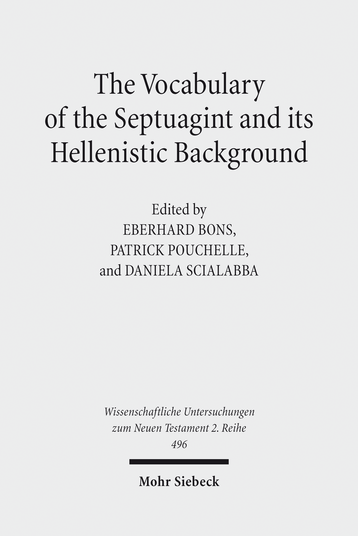
 Από τον εκδοτικό οίκο Mohr Siebeck κυκλοφόρησε ένας συλλογικός τόμος με θέμα την ανάλυση του λεξιλογίου της μετάφρασης των Ο΄ και την αναζήτηση των ελληνιστικών καταβολών του. Ο τόμος φιλοξενεί μελέτες από ειδικούς, οι οποίες παρουσιάστηκαν σε επιστημονικές συναντήσεις κατά το 2013 και 2017 και αποτελούν μέρος του ερευνητικού προγράμματος Historical and Theological Dictionary of the Septuagint. Μέσα από την ανάλυση συγκεκριμένων παραδειγμάτων οι μελέτες του τόμου αποπειρώνται να απαντήσουν σε μία σειρά ερευνητικών ερωτημάτων: ποια ήταν η σημασία, η χρήση κι εξέλιξη λέξεων που απαντούν στη μετάφραση των Ο΄; Πού και πώς χρησιμοποιούνται αυτές οι λέξεις μέσα στη μετάφραση των Ο΄ κι ως ποιο σημείο αντιστοιχούν ως προς τη σημασία στις εβραϊκές ή αραμαϊκές λέξεις που αποδίδουν; Πώς μπορούν οι πάπυροι να βοηθήσουν στην καλύτερη κατανόηση αυτών των λέξεων;
E. Bons - P. Pouchelle - D. Scialabba, The Vocabulary of the Septuagint and its Hellenistic Background. WUNT II.496. Tübingen: Mohr Siebeck, 2019
157 σσ.
69,00 €
Περιεχόμενα
- Eberhard Bons/Patrick Pouchelle/Daniela Scialabba, "Introduction"
- Anna Passoni Dell'Acqua, "Le vocabulaire de la Septante à la lumière des papyrus Nesina Grütter: Die Blöße der Stadt-Frauen: Überlegungen zur Verwendung der Substantive αἰσχύνη und ἀσχημοσύνη und in der Septuaginta"
- Patrick Pouchelle, "La main de Cyrus ou la main de Dieu? Étude de l'expression ἀποστέλλω τὴν χεῖρα dans la Septantε"
- Justus Ghormley, "Coining Silver: The Translation of kæsæp in the Septuagint"
- Marieke Dhont, "Why is God not designated as an ἄρχων in the Septuagint?"
- Daniela Scialabba, "οὗτος δὲ οὐδὲν ἄτοπον ἔπραξεν (Luke 23:41). What Did the Good Thief Want to Say? A New Testament Citation and its Papyrological Background"
- David S. Hasselbrook, "Nuances of Meaning with Compound Words in the Septuagint: A Case Study of διαγογγύζω and εἰσακούω in Contexts of Grumbling"
- Eberhard Bons, "Die Übersetzung παρὰ τὰς διεξόδους τῶν ὑδάτων in Psalm 1,3 und ihr griechischer Hintergrund"
- Kyriakoula Papademetriou, "The Semantic Evolution of the Word παρρησία through its Pragmatic and Sociolinguistic Fields"
- Beatrice Perego, "Παράδεισος and Κῆπος: The Garden Terminology of the Septuagint"
- Miriam Carminati, "The Verb συναντιλαμβάνομαι: The History of a New Compound Created in the Hellenistic Epoch"


