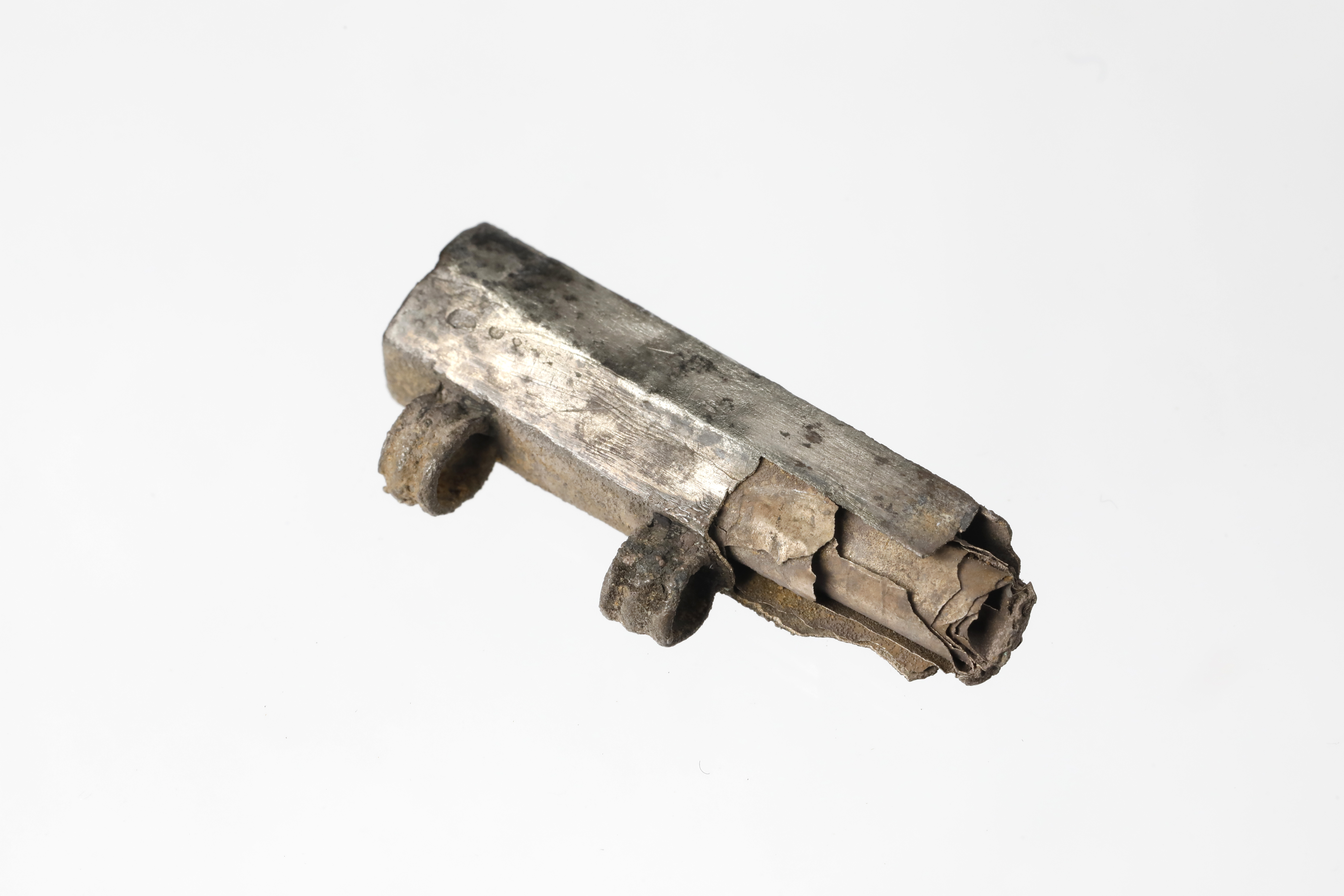
Εμφάνιση αναρτήσεων με ετικέτα μαγεία. Εμφάνιση όλων των αναρτήσεων

Παρασκευή 9 Σεπτεμβρίου 2022

Το τρέχον τεύχος του NTS / The current issue of NTS

 New Testament Studies 68/4 (2022)

Σάββατο 20 Αυγούστου 2022

Στο τρέχον τεύχος του Greece & Rome / In the current issue of Greece & Rome

Greece & Rome 69/1 (2022)

Curses in Context IV: Curse Tablets in the Wider Realms of Execrations, Commerce, Law, and Technology 

Πέμπτη 10 Μαρτίου 2022

Το τρέχον τεύχος του NTS / The current issue of NTS

New Testament Studies 68/2 (2022)

  • Margaret M. Mitchell, "John Chrysostom and Christian Love Magic: A Spellbinding Moment in the History of Interpretation of 1 Cor 7.2–4," 119-143 (abtsract)
  • Rowe C. Kavin, "What if it were True? Why Study the New Testament," 144-155 (abstract)
  • Garrick V. Allen, "Titles in the New Testament Papyri," 156-171 (open access)
  • Matthew Pawlak, "Paul's Escape from Damascus (2 Cor 11.32–3) and the corona muralis," 172-187 (open access)
  • David A. Evans, "Κολληθέντɛς in Acts 17.34 and the Establishment of the Athenian Church," 188-205 (abstract)
  • Ivan Miroshnikov, "A New Witness to the Fayyūmic Version of First Corinthians (P.MorganLib. 265). Part II: Notes on its Text-Critical Value, with an Edition of the Coptic Text,"  206-230 (open access)  

Τρίτη 1 Φεβρουαρίου 2022

Το τρέχον τεύχος του JSJ / The current issue of JSJ

 Journal for the Study of Judaism 53/1 (2022)

Σάββατο 7 Αυγούστου 2021

Το τρέχον τεύχος του RRE / The current issue of RRE

 Religion in the Roman Empire 7/1 (2021)

Curses in Context, 2: Curses in the Eastern and North African Provinces of the Roman Empire

  • Richard L. Gordon, "Curse-Practices in the Late-Antique Roman Levant and North Africa," 3-18 (abstract)
  • Roger S. O. Tomlin, "The Latin Curses from Uley and Other Sanctuaries in Britain," 19-30 (abstract)
  • Riccardo Vecchiato, "Crucified and Beheaded: The Archaeological Context of the Amathous Curses (DTAud 22–37)," 31-42 (abstract)
  • Andrew T. Wilburn, "The Selenite and Lead Curse Tablets from Amathous, Cyprus and the Transmission of Magical Technology," 43-70 (abstract)
  • Robert Daniel, "A Vestige of the Ptolemaic Crocodile Cult in a Curse from Caesarea Maritima against a Pantomime Dancer," 71-77 (abstract)
  • Attilio Mastrocinque, "Cursing Dancers in the Roman Levant: A Forgotten Text in Milan," 78-95 (abstract)
  • Raquel Martín Hernández, "The Figural Representation of Victims on Agonistic Late-Antique Curse Tablets," 96-124 (abstract)
  • Christopher A. Faraone, "The Curse Tablets of PGM VII: A North African Tradition?" 125-148 (abstract)
  • Ortal-Paz Saar, "Jewish Curse Tablets?" 149-166 (abstract)
  • Korshi Dosoo, "The Powers of Death: Memory, Place and Eschatology in a Coptic Curse," 167-194 (abstract)
  • Nicole Belayche, "Curse Tablets in the Eastern Provinces of the Roman Empire," 195-213 (abstract)


Παρασκευή 16 Ιουλίου 2021

Το τρέχον τεύχος του JBL / The current issue of JBL

 Journal of Biblical Literature 140/2 (2021)

  • David J. A. Clines, "Alleged Female Language about the Deity in the Hebrew Bible," 229-249 (abstract)
  • David M. Carr, "Competing Construals of Human Relations with “Animal” Others in the Primeval History (Genesis 1–11)," 251-269 (abstract)
  • Paba Nidhani De Andrado, "Hannah’s Agency in Catalyzing Change in an Exclusive Hierarchy," 271-289 (abstract)
  • Will Kynes, "Wrestle On, Jacob: Antebellum Spirituals and the Defiant Faith of the Hebrew Bible," 291-307 (abstract)
  • Hindy Najman, "Imitatio Dei and the Formation of the Subject in Ancient Judaism, 309-323 (abstract)
  • Troy M. Troftgruben, "The Ending of Luke Revisited, " 325-346 (abstract)
  • Laura Salah Nasrallah, "Judgment, Justice, and Destruction: Defixiones and 1 Corinthians," 347-367 (abstract)
  • T. Christopher Hoklotubbe, "Civilized Christ-Followers among Barbaric Cretans and Superstitious Judeans: Negotiating Ethnic Hierarchies in Titus 1:10–14," 369-390 (abstract)
  • Kim Papaioannou, "The Sin of the Angels in 2 Peter 2:4 and Jude 6," 391-408 (abstract)
  • TGarrick V. Allen, "The Possibilities of a Gospel Codex: GA 2064 (Dublin, CBL W 139), Digital Editing, and Reading in a Manuscript Culture," 409-434 

Τρίτη 6 Ιουλίου 2021

Το τρέχον τεύχος του Early Christianity / The current issue of Early Christianity

 Early Christianity 12/2 (2021)

  • Isaac T. Soon, "The Short Apostle: The Stature of Paul in Light of 2 Cor 11:33 and the Acts of Paul and Thecla," 159-178 (abstract)
  • Stefan Krauter, "Foul! Romans 9–11 and Athletic Contests in Ancient Epic," 179-199 (abstract)
  • Beatrice Wyss, "Die Brotrede Philons aus Alexandreia in Legum allegoriae 3,169–178," 200-227 (abstract)
  • Carl Johan Berglund, "References to Heracleon in Clement of Alexandria," 228-247 (abstract)

New Discoveries 

  • Roy D. Kotansky, "The So-Called »Christ« Magician's Cup," 251-261

New Projects

  • Tobias Nicklas,  "»Beyond Canon«: Eine kurze Erläuterung des Projekts," 265-275

Παρασκευή 5 Μαρτίου 2021

Γυναίκες και μαγεία στην Παλαιά Διαθήκη; / Women and magic in the Old Testament

 Ο Jonathan Rabinowitz (Bar Ilan University) συζητά τη μοναδική περίπτωση μέσα στην Παλαιά Διαθήκης πιθανής αναφοράς σε γυναίκες μάγισσες κι εξηγεί πώς η γενικότερη σύνδεση της μαγείας με τη γυναίκα στον αρχαίο πέρασε και στην ιστορία πρόσληψης του συγκεκριμένου χωρίου: 

Accusing Women of Witchcraft

Δευτέρα 22 Φεβρουαρίου 2021

Πέμπτη 18 Φεβρουαρίου 2021

Στο τρέχον τεύχος του HTR / In the current issue of HTR

 Harvard Theological Review 114/1 (2021)

  • Harry Tolley, "The Jewish–Christian Dialogue Jason and Papiscus in Light of the Sinaiticus Fragment," 1-26 (abstract)
  • Eugene C. Tibbs, "'Do Not Believe Every Spirit': Discerning the Ethics of Prophetic Agency in Early Christian Culture," 27-50 (abstract)
  • Sarah Parkhouse, "Identity, Death, and Ascension in the First Apocalypse of James and the Gospel of John," 51-71 (abstract)
  • Amit Gvaryahu, "Usury and Poverty: A Case Study of the Post-Rabbinic Moment in Midrash and Piyyut," 72-95 (abstract)
  • Michael Motia, "Three Ways to Imitate Paul in Late Antiquity: Ekstasis, Ekphrasis, Epektasisl," 97-117 (abstract)
  • Lincoln H. Blumell, Korshi Dosoo, "A Coptic Magical Text for Virginity in Marriage: A Witness to “Celibate Marriage” from Christian Egypt," 118-142 (abstract)


Τρίτη 15 Δεκεμβρίου 2020

Στο τρέχον τεύχος του JJS / In the current issue of JJS

 Journal of Jewish Studies 71/2 (2020)

Avigail Manekin-Bamberger, "Who were the Jewish ‘magicians’ behind the Aramaic incantation bowls?" 235-254

This article focuses on the social and professional contexts of the producers of Jewish Aramaic incantation bowls. Based on the vast amount of legal terminology deployed in the bowls, as well as a reference to bowl writers as ‘writers of books’ in bowl AMB6, I argue that bowl scribes were part of a professional guild of scribes (soferim) that engaged in a variety of forms of Jewish writing. Furthermore, I suggest that the scribal context of the practitioners of the magic bowls was different from the professional context of the contemporaneous corpus of Jewish metal amulets. Identifying the unique Sitz im Leben of the bowls reveals that for Jews in Sasanian Babylonia the line between magic, law and religion was not rigid, and perhaps non-existent. Further work on the context of ancient Jewish magic may therefore lead to new perceptions of ancient Jewish society.

Sonja Noll, "In pursuit of a hapax: divergent interpretations of the root s-k-t," 255-268

A shift occurred in the lexicographical tradition of the hapax legomenon הַסְכֵּת (Deut. 27:9) between the seventeenth and nineteenth centuries. The hiphil imperative had previously been understood to mean ‘listen’ or ‘pay attention’, a tradition reflected in the Targumim, Peshitta, Vulgate, Aquila and early dictionaries. With the introduction of Arabic cognate evidence into Hebrew dictionaries in the seventeenth century, however, the meaning ‘be silent’, from the Arabic cognate سكت, began to appear in entries for this root. Dictionaries also began to include the translation σιώπα, ‘be silent’, from the Greek Septuagint, and eventually the gloss ‘be silent’ replaced ‘listen’ in bilingual biblical Hebrew dictionaries. The difference in meaning is minor, but this case study serves to illustrate the striking influence of cognate scholarship on the development of biblical Hebrew dictionaries.

Reuven Friedman, "A tale of two baraitot: the Western Galilee borders of the rabbis in archaeology and texts," 269-296

The purported border of Jewish settlement in the Western Galilee is identified in two separate tannaitic texts, each referring to the ̔Akko–Akhziv road. One text cites this road as the western border of Jewish settlement, while the other cites the same road as the eastern border. The border of Jewish settlement is also described in another rabbinic text, also discovered in the Reḥov synagogue excavations. This text is inconsistent with the texts referring to the ̔Akko–Akhziv road. Archaeologists give priority to the Reḥov inscription and dismiss the contradictory texts as a scribal error. Talmudic scholars validate the authenticity of the apparently contradictory texts using critical textual analysis, but leave the apparent contradictions unresolved. This article uses archaeological evidence in conjunction with a critical review of the texts to resolve the apparent contradiction, proving that the rabbinic texts authenticated by Talmudic scholars are consistent with the Reḥov inscription.

Πέμπτη 15 Οκτωβρίου 2020

Στο τρέχον τεύχος του JJS / In the current issue of JJS

 Journal of Jewish Studies 7/1 (2020)

  • Avigail Manekin-Bamberger, "Who were the Jewish ‘magicians’ behind the Aramaic incantation bowls?" 253-268 (abstract)
  • Sonja Noll, "In pursuit of a hapax: divergent interpretations of the root s-k-t,"  255-268 (abstract)
  • Reuven Friedman, ''A tale of two baraitot: the Western Galilee borders of the rabbis in archaeology and texts," 269-296 (abstract)


Παρασκευή 21 Αυγούστου 2020

Στο τρέχον τεύχος του Arethusa / In the current issue of Arethusa

Arethusa 53/1 (2020)

  • Cat Lambert, "The Ancient Entomological Bookworm," 1-24
  • Charlotte Northrop, "Caeneus and Heroic (Trans)Masculinity in Ovid’s Metamorphoses," 25-41 (abstract)
  • David Frankfurter, "“Voodoo Doll”: Implications and Offense of a Taxonomic Category," 43-58 (abstract)

Κυριακή 12 Απριλίου 2020

Το τρέχον τεύχος του Revue Biblique / The current issue of Revue Biblique

Revue Biblique 127:1 (2020)

  • Grzegorz M. Baran, "'Mother of the Nation (mḗtēr éthnous)' (4 Macc. 15:29): Mother of Seven Maccabaean Sons as Patriarchess of New-Quality Nation," 5 - 34 (abstract)
  • Markus Lau, "Capta et devicta? Eine mk Gegenerzählung zur römischen Judaea-Capta-Münzprägung - Anmerkungen zur literarischen Technik einer narrativen Münzüberprägung in Mk 5,1-20," 35 - 63 (abstract)
  • Anne de Saxcé, "La citation dans la pensée de saint Augustin," 64 - 81 (abstract)
  • Reinhard Pummer, "What was the Meaning and Purpose of Amulets with Samaritan Writing in the Byzantine Period?" 82 - 104 (abstract)
  • Madeleine Mumcuoglu - Yosef Garfinkel, "Gate Piazza and Cult at Iron Age IIA Tell el-Far'ah North," 105 - 129 (abstract)
  • Lucie Duvignac - Awni Shawamra, "Des sarcophages samariens conservés à Jénine," 130 - 135


Παρασκευή 17 Ιανουαρίου 2020

Στο τρέχον τεύχος του RRE / In the current issue of RRE

Religion of the Roman Empire 5/2 (2019)

  • Julien Aliquot, "Heliopolitan Capitolia: From Greek Games to Christian Pilgrimage," 145-169 (abstract)
  • Jonathan A. Pomeranz, "The Humility of God in Rabbinic Judaism: Rabbinic Myth in the Roman Empire," 170-195 (abstract)
  • Jason J. Ripley, "The Genre of John and the Rule of Rome: Imperial Readers, Johannine Testimony, and the Death of the Author," 196-245 (abstract)
  • Jan N. Bremmer, "Simon Magus: The Invention and Reception of a Magician in a Christian Context,"  246-270 (abstract)
  • Maik Patzelt, "'Praying as a 'Woman among Men': Reconsidering Clodius' Failed Prayer in Cicero's Speech On his House," 271-291 (abstract)
  • Jörg Rüpke, "Roman Gods and Private Property: The Invention of State Religion in Cicero's Speech On His House," 292-315 (abstract)


Σάββατο 5 Οκτωβρίου 2019

Στο τρέχον τεύχος του BASP / In the current issue of BASP

Bulletin of the American Society of Papyrologists 56 (2019)

  • Nikos Litinas, "On the Usefulness of the North Wind in a Chreia Diogenis Cynici (P.Mich. inv. 6216z20): An Ancient Student Response Card?" 39-53 (abstract)
  • Lajos Berkes - W. Graham Claytor, "Two Petitions Addressed to Village Epistatai," 55-63 (abstract)
  • Matt Gibbs - C. Michael Sampson, "A First-Century Receipt from the Receivers of Public Clothing in Tebtunis (P.Tebt.UC 1607c)," 65-78 (abstract
  • Adrienn Almásy-Martin -   Ruth Duttenhöfer, "Greek Tax Receipts from Abydos in the British Museum," 79-93 (abstract)
  • Giulio Iovine, "Unpublished Latin Papyri from Dura-Europos at the Beinecke Library," 95-116 (abstract)
  • Graziano Ranocchia, "P.Herc. 1015/832: Book 15, 16, or 19 of Philodemus' On Rhetoric?" 167-172 (abstract)
  • Jacob W. Peterson, "An Updated Correction List for Chester Beatty BP II + P.Mich. Inv. 6238 (Gregory-Aland Papyrus 46 [P46])," 173-195 (abstract)
  • Richard L. Phillips, "Ritual Evidence and the Art of Going Unnoticed in PGM I 222-231 and 247-262," 197-203 (abstract)
  • Christopher A. Faraone, "Protection against Fear of Punishment from Hecate Ereschigal: Another Look at a Magical Recipe in Michigan (PGM LXX 4-19)," 205-224 (abstract)
  • Eddy Lanciers, "Antaios, a Ptolemaic Strategos of Alexandria," 225-231 (abstract)
  • Thomas Backhuys, "Apomoira für die Rachegöttinnen: Neuedition von PUG 4.155," 233-249 (abstract)
  • Charikleia Armoni, "Notes on Papyri," 251-257 (abstract)
  • Ines Bogensperger - Aikaterini Koroli, "Textile Terminology in the Apollonios Archive: A New Approach to the Meaning of Entype in P.Giss.Apoll. 20," 259-274 (abstract)
  • A. Papathomas - N. Kanavou, "P.Philammon, 'Law Cases' 1-6 (= BGU 4.1024, pp. 3.1-6.2): Some Textual Notes," 275-286 (abstract)

Τρίτη 13 Αυγούστου 2019

Ένα κουτί γεμάτο μαγικά αντικείμενα / A box full of magic objects

Stones, bones and other artefacts on display in Pompeii (12 August)
Τα αντικείμενα που περιείχε το ξύλινο κουτί της Πομπηίας (Φωτο:
BBC) 
Αρχαιολόγοι που εργάζονται στην ανασκαφή της Βίλλας του Κήπου στην Πομπηία έφεραν στο φως ένα κουτί γεμάτο αντικείμενα που συνδέονται με τον κόσμο των γυναικών και τα οποία οι ανασκαφείς εκτιμούν ότι χρησιμοποιούνταν ως μαγικά αντικείμενα. Κατά τους ίδιους μάλλον ανήκαν σε κάποιον δούλο της οικίας. Στον ίδιο χώρο οι αρχαιολόγοι εντόπισαν 10 θύματα της έκρηξης του Βεζουβίου: