Mahri Leonard-Fleckman, "Scribal Innovation, Education, and the Female Body in Ezekiel and Proverbs," 35-30 (abstract)
Κυριακή 25 Αυγούστου 2019


Μυρωδιές στη Βίβλο / Scents in the Bible
Διαβάστε το άρθρο του Ted Harrison στην ηλεκτρονική εφημερίδα Church Times σχετικά με τις βιβλικές αναφορές σε αρώματα και μυρωδιές:
Η γενεαλογία του Μαννασή / Mannaseh's genealogy
Στο ιστολόγιο TheTorah ο Aaron Demsky συγκρίνει τις τρεις διαφορετικές γενεαλογήσεις της φυλής Μαννασή (Αρθ 26· Ιησ 17· 1Χρον 7) και προτείνει εξηγήσεις για αυτές:
Στο τρέχον τεύχος του TynBull / In the current issue of TynBull
Tyndale Bulletin 70:1 (2019)
Benjamin Foreman, "Sacrifice and Centralisation in the Pentateuch: Is Exodus 20:24-26 Really at Odds with Deuteronomy?" 1-22
Benjamin Foreman, "Sacrifice and Centralisation in the Pentateuch: Is Exodus 20:24-26 Really at Odds with Deuteronomy?" 1-22
Many scholars believe Exodus 20:24-–26 and Deuteronomy 12:1-–28 present contradictory regulations on how and where to sacrifice. Exodus 20:24-–26 seems to imply that sacrificial altars can be built at any location throughout the country, while Deuteronomy appears to prohibit all sacrifice outside of the central place of worship. Scholars have dealt with this discrepancy in various ways. In this paper I show how none of these explanations hold up to closer scrutiny and argue that both texts simply address different types of sacrifices permitted in ancient Israel.
Christopher Seglenieks, "Faith and Narrative: A Two-Level Reading of Belief in the Gospel of John," 23-40
The question of who truly believes according to John's Gospel can be unclear, complicated by characters who display contradictory evidence, both portrayed positively yet also reflecting imperfections. A solution to the confusion lies in attending to the overt narration of the Gospel, which creates a distinction between events within the story and the presentation to the reader. Positive expressions of faith within the story can be identified as 'acceptable belief', involving commitment to Jesus but with a limited understanding of his identity and mission. Only after the cross is 'genuine belief', (which includes greater under¬standing), possible.
Elaine A. Phillips, "The Pools of Siloam: Biblical and Post-Biblical Traces," 41-54
Scholars celebrated the 2004 discovery of a large first- century pool at the southern end of Jerusalem's City of David. That pool and the related complex of underground conduits are archaeological echoes of biblical texts from both First and Second Temple periods. Potential identifications of and connections among these vital water sources are already evident in language employed in biblical and post-biblical texts, are reflected in centuries of travellers' reports, and appear in nineteenth- and twentieth- century maps. Data from each of these categories contribute to our comprehensive understanding of the water systems that served Jerusalem through the millennia.
Bob Wagner, "Why Derbe? An Unlikely Lycaonian City for Paul's Ministry (Tacoma, Washington) and Mark Wilson," 55-84
This article discusses Paul's visit to Derbe contextually within the first journey as well as his subsequent visits to this minor Lycaonian city. It reviews the difficulty of earlier travellers and scholars such as Davis, Sterrett, and Ramsay to localise the site. The discovery of two inscriptions naming Derbe have more precisely situated the site, yet some ambiguity remains. Paul's projected routes between Lystra and Derbe as presented in maps and atlases are reviewed. The authors' autopsy of this area provides fresh insights into Paul's route between the two cities. The article closes with a suggested reason why Paul visited Derbe on his first journey and thereby founded a community of believers there.
Vicky Balabanski, "Colossians 1:23: A Case for Translating ἐπιμένετε (Continue) as Imperative, not Indicative," 85-94
This paper presents a morphological observation about a verbal form in Colossians 1:23 that potentially has several significant implications. The paper is, first, a foray into an important new methodological approach, namely the study of the divisions displayed in the earliest Greek manuscript witnesses. Second, it is an exploration of the meaning of εἴ γε (traditionally translated here as 'provided that' or 'if indeed'), and whether in this context the particle γε modalises εἰ in such a way that the meaning of this composite form is 'if so', or 'this being the case', or 'accordingly', followed by the imperative. Third, the paper argues that interpreting ἐπιμένετε (continue) as imperative, not indicative, is a less problematic way of reading Colossians 1:23, both linguistically and theologically, than the traditional reading.
Σάββατο 24 Αυγούστου 2019
To τρέχον τεύχος του JSNT / The current issue of JSNT
Journal for the Study of the New Testament 42:1 (2019)
- Jason A. Staples, "‘Rise, Kill, and Eat’: Animals as Nations in Early Jewish Visionary Literature and Acts 10," 3-17 (abstract)
- Michael Flexsenhar, III, "The Provenance of Philippians and Why it Matters: Old Questions, New Approaches," 18-45 (abstract)
- Roberta Mazza, "Dating Early Christian Papyri: Old and New Methods – Introduction," 46-57 (abstract)
- Malcolm Choat, "Dating Papyri: Familiarity, Instinct and Guesswork," 58-83 (abstract)
- Brent Nongbri, "Palaeographic Analysis of Codices from the Early Christian Period: A Point of Method," 84-97 (abstract)
- Sarah Goler, James T. Yardley, David M. Ratzan, Roger Bagnall, Alexis Hagadorn, James McInerney, "Dating Ancient Egyptian Papyri through Raman Spectroscopy: Concept and Application to the Fragments of the Gospel of Jesus’ Wife and the Gospel of John," 98-133 (abstract)
Το τρέχον τεύχος του Textus / The current issue of Textus
Textus 28:1 (2019)
- Anneli Aejmelaeus, "Was Samuel Meant to Be a Nazirite? The First Chapter of Samuel and the Paradigm Shift in Textual Study of the Hebrew Bible," 1–20 (abstract)
- Alessandro Maria Bruni, "The Second Church Slavonic Translation of 1–4 Kingdoms: A Witness to the Proto-Lucianic Text," 21–44 (abstract)
- Julian C. Chike, "The Literary Development of MT 1 Kings 8:1–11 in Light of the Septuagint," 45–66 (abstract)
- Bradley J. Marsh Jr., "'Darius Son of Ahasuerus, King of the Persians': Textuality and Chronology in Jacob of Edessa’s Book of Daniel," 67–104 (abstract)
- Daniel Olariu, "Criteria for Determining the Common Basis of the Greek Versions of Daniel," 105–124 (abstract)
- Michael Shepherd, "Haggai and Zechariah in Greek Psalm Superscriptions," 125–144 (abstract)
- Richard C. Steiner, "On the Use of Greek Translations in Dating the Shift from Targum Proto-Jonathan to Targum: Yerushalmi in Ezekiel," 145–156 (abstract)
- Sarah Yardney, "The Use of Glossaries by the Translators of the Septuagint," 157–177 (abstract)
Παρασκευή 23 Αυγούστου 2019
Μία βιβλική μάχη 2.800 χρόνων / A biblical battle 2.800 years old
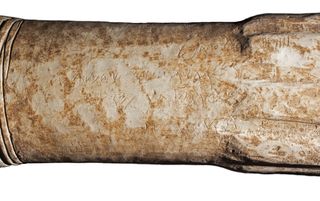 |
| Η επιγραφή από το μωαβιτικό βωμό της Ataroth (Φωτο: Adam Bean) |
Μία επιγραφή που πρόσφατα βρέθηκε στην αρχαία πόλη Ataroth (Ιορδανία) έρχεται να συμπληρώσει τις πληροφορίες που είχαμε ως τώρα για την επανάσταση του βασιλιά της Μωάβ, Mesha εναντίον του Βασιλείου του Ισραήλ. Η επανάσταση υπήρξε επιτυχής κι η πόλη Ataroth πέρασε στα χέρια των Μωαβιτών. Το γεγονός αναφέρεται και στη γνωστή Στήλη της Mesha. H νέα επιγραφή, η οποία ήταν χαραγμένη σε βωμό μωαβιτικού ιερού που ήρθε στο φως κατά τις ανασκαφές στην αρχαία Ataroth το 2010, κάνει επίσης λόγο για την κατάληψη της πόλης από τους Μωαβίτες και τα λάφυρα που προσφέρθηκαν στο ιερό. Μία άλλη επιγραφή από τον ίδιο βωμό ίσως κάνει λόγο για τα περιστατικά της κατάληψης της πόλης:
Το θαύμα του χορτασμού σε ένα ψηφιδωτό από τη Γαλιλαία / The Miracle of the Multiplication in a Byzantine Mosaic from Galilee
 |
| Η βασιλική στην Αντιόχεια Ίππου, 5ος αι. μ.Χ. (Φωτο: Dr. Michael Eisenberg) |
Στην ηλεκτρονική έκδοση της Haaretz μπορείτε να διαβάσετε την περιγραφή και το σχολιασμό των ψηφιδωτών που βρέθηκαν στη βασιλική του 5ου αιώνα που πρόσφατα (Ιούλιος 2019) ήρθε στο φως στην Αντιόχεια-Ίππου (Sussita) στη Γαλιλαία. Τα ψηφιδωτά φαίνεται να απεικονίζουν το θαύμα του χορτασμού των 5.000 όπως μαρτυρείται στα ευαγγέλια. Ως τόπος όπου έλαβε χώρα το θαύμα συνήθως θεωρείται η Tibgha, όπου και πάλι έχει βρεθεί ένα ανάλογο ψηφιδωτό, πολλοί όμως ερμηνευτές θεωρούν τη Δεκάπολη και την περιοχή της Αντιόχειας ως πιθανότερο τόπο. Σε κάθε περίπτωση η εύρεση αυτού του νέου ψηφιδωτού θέτει ενδιαφέροντα ερωτήματα για τις αρχαίες χριστιανικές κοινότητες της περιοχής και πώς έβλεπαν τη σύνδεσή τους με την ιστορία των ευαγγελίων:
H ιστορία μίας νεαρής μουσικού / The story of a young female music player
Στην εξαιρετική ιστοσελίδα Papyrus Stories φιλοξενείται το άρθρο του Luigi Prada για μία νεαρή μουσικό, την Kheredankh, η οποία έζησε και πέθανε στα χρόνια της Κλεοπάτρας στην Αίγυπτο. Μέσα από την ανάλυση της επιγραφής και άλλων επιγραφικών μνημείων που συνδέονται με την οικογένεια, ο Prada παρουσιάζει την ιστορία της οικογένειας της Kheredankh και την εντάσσει μέσα στο ιστορικό πλαίσιο της εποχής. Ας σημειωθεί ότι το επιτάφιο μνημείο της Kheredankh παρουσιάζει ένα επιπλέον ενδιαφέρον, καθώς είναι ένα από τα λιγοστά επιγραφικά μνημεία της Αιγύπτου που αναφέρει το όνομα του γιου της Κλεοπάτρας, Καισαρίωνα:
Πέμπτη 22 Αυγούστου 2019
"Good Omens" και η τροφή των Αγγέλων / "Good Omens" and the Good of Angels
Η σειρά Good Omens η οποία κυκλοφόρησε από την Amazon Prime τον Μάιο 2019 και στηρίζεται στο ομώνυμο βιβλίο του Terry Pratchett έχει προκαλέσει το ενδιαφέρον των βιβλικών θεολόγων, ιδίως όσων ασχολούνται με την αποκαλυπτική και την ιουδαϊκή ψευδεπίγραφη γραμματεία. Ήδη προετοιμάζεται ένας ενδιαφέρων τόμος με κείμενα σχετικά με την πρόσληψη τέτοιων κειμένων στη σειρά και το βιβλίο κι υπάρχουν κάποιες σχετικές αναρτήσεις στο διαδίκτυο. Η Meredith J.C. Warren παίρνει αφορμή από μία σκηνή στο πρώτο επεισόδιο της σειράς και συζητά τον τρόπο που κατανοεί η ιουδαϊκή παράδοση την ικανότητα των αγγέλων να καταναλώνουν τροφή και ποια είναι η τροφή των αγγέλων:
Εγγραφή σε:
Σχόλια (Atom)